
The Sustainable Development Goals Report (SDGs) serves as a vital instrument for evaluating global and regional advancements toward the ambitious 2030 Agenda for Sustainable Development. Produced and updated annually by the United Nations, this comprehensive document provides crucial insights into the collective efforts and ongoing challenges in achieving the Sustainable Development Goals. This article delves into the core significance and structural components of an SDGs Progress Report, with a particular focus on key highlights from the 2022 edition, known as the SDGs 2022 Report. Understanding these reports is essential for stakeholders worldwide to monitor progress, inform policy decisions, and drive impactful actions for a sustainable future.
In this article, we will explore the significance and components of a Sustainable Development Goals Progress Report, as well as provide an overview of some of the highlights from the 2022 report (SDGs 2022 Report).
Why is a Sustainable Development Goals Progress Report important?
The United Nations’ Sustainable Development Goals Report is the definitive publication for tracking global progress toward the 2030 Agenda for Sustainable Development. This report is critical for assessing advancements across the 17 Sustainable Development Goals (SDGs).
Since 2013, countries have actively worked on the United Nations development agenda post-2015, which included defining the set of 17 SDGs. The 2030 Agenda, encompassing these 17 Sustainable Development Goals, was formally adopted at the United Nations Summit in September 2015 by 193 member nations.
The United Nations conducts the Sustainable Development Goals Report, which is updated yearly. The most recent edition covered in detail is the SDGs 2022 Report. Utilizing the most current data and estimations available, the SDGs 2022 Report provides an essential overview of progress in achieving the SDGs, thereby assisting the global community in monitoring the substantial impact of various crises on people’s lives and livelihoods.
Consequently, this report is crucial for providing vital information that serves as a foundation for policy decisions, strengthens accountability, and motivates robust SDG implementation. It also helps in measuring the effectiveness of programs, identifying specific issues that require attention, and formulating recommendations to accomplish the 17 Sustainable Development Goals.
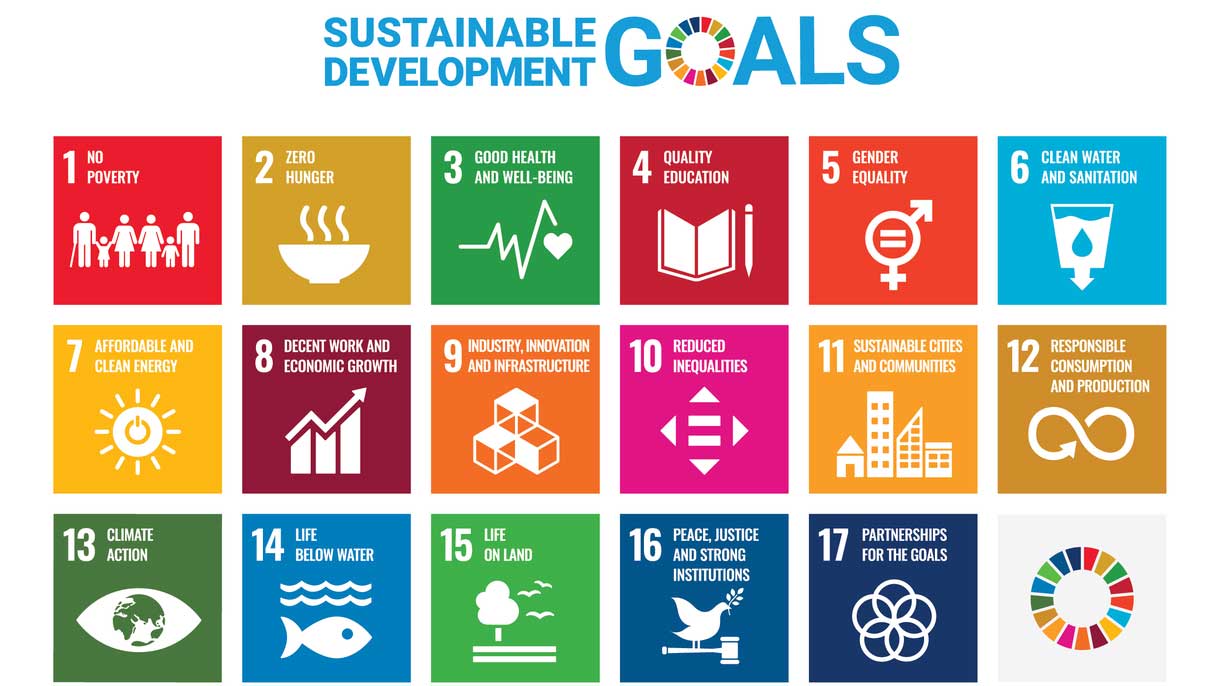 17 Sustainable Development Goals of the United Nations (Image Source: Internet)
Highlights from the Sustainable Development Goals Report 2022
A Sustainable Development Goals Report typically consists of two main sections: an overview providing a general assessment of progress in implementing the 17 SDGs within the current global context, and a detailed section presenting precise statistics for each specific SDG.
The SDGs 2022 Report particularly highlighted that the aspirations of the 2030 Agenda for Sustainable Development face significant challenges as the world contends with escalating crises and conflicts. The prolonged Covid-19 epidemic, now in its third year, and the conflict in Ukraine have exacerbated critical concerns related to food security, energy access, health systems, environmental degradation, peace, and global security.
Furthermore, the pervasive global effects of climate change intensify the severity of these challenges. These issues are thoroughly explained in the report’s introductory section before it transitions to provide comprehensive updates on each SDG. The main body of the report offers global updates on the progress of all 17 Sustainable Development Goals. For instance, under SDG7 on affordable and clean energy, the report notes that progress needs to accelerate considerably to achieve Goal 7 by 2030.
Improvements in energy efficiency, for example, will need to accelerate significantly to reach the climate goal of reducing greenhouse gas emissions. In some countries, the COVID-19 pandemic has weakened or even reversed previous advances. Rising commodity, energy, and shipping prices have increased the cost of producing and transporting solar photovoltaic modules, wind turbines, and biofuels, among other technologies. Achieving energy and climate goals will therefore require continued strong policy support and massive public and private capital mobilization for clean and renewable energy, especially within developing nations.
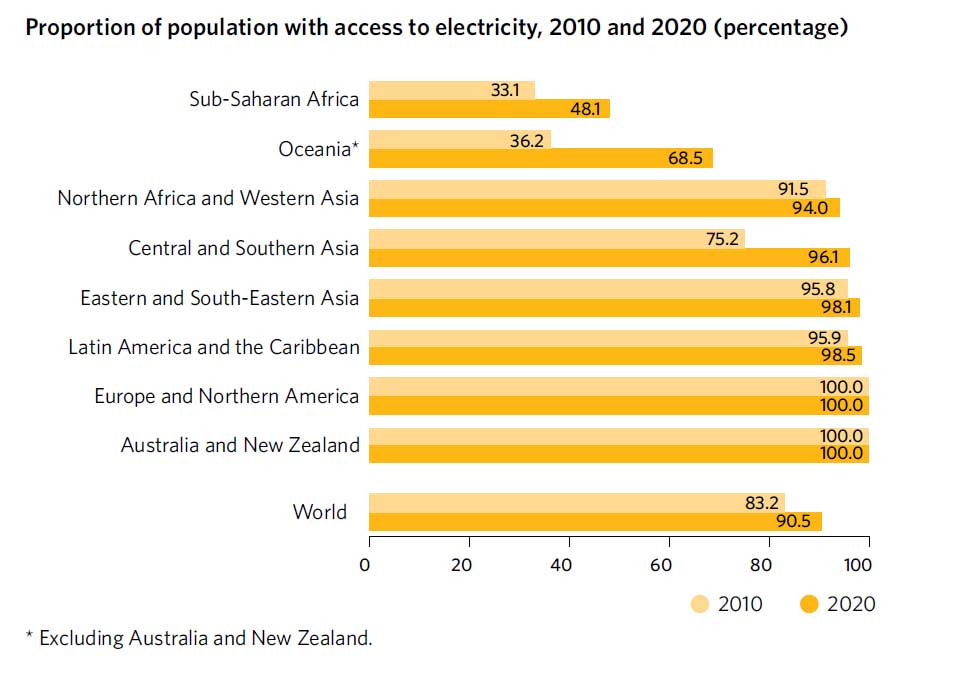 Proportion of population with access to electricity, 2010 and 2020 (percentage) – image from the UN SDGs 2022 Report
According to data from the SDGs 2022 Report, the global electricity access rate increased from 83% in 2010 to 91% in 2020. Over this period, the number of people without electricity shrank from 1.2 billion to 733 million, yet the complexity of reaching those hardest to serve simultaneously increased.
In the period of 2018–2020, the electricity access rate rose by an average of 0.5 percentage points annually, a slowdown compared to the 0.8 percentage points observed in 2010–2018. By 2020, over three-quarters (77%) of the global population lacking electricity lived in sub-Saharan Africa, primarily in rural areas.
The report projects that if current trends persist, only 92% of the world’s population will have access to electricity by 2030, leaving 670 million people unserved. A major, concerted push is therefore critically needed to reach those residing in the least developed countries and in fragile and conflict-affected regions.
The process of building the Sustainable Development Goals Report
The SDGs 2022 Report is a collaborative effort involving the Department of Economic and Social Affairs and more than 50 international and regional agencies. Its compilation is based on millions of data points gathered from over 200 countries and areas. The process of building this Sustainable Development Goals Report encompasses comprehensive data collection, rigorous analysis, and meticulous progress assessment. Organizations and countries must establish a well-organized and tightly managed process to ensure the accuracy and reliability of all data and information presented.
While creating a Sustainable Development Goals Report faces challenges, such as ensuring accurate data, managing complex information, and securing the participation and collaboration of multiple stakeholders, it offers several essential advantages. These benefits include providing a clear overview of global and regional progress toward achieving the SDGs, and consequently, suggesting improvements for enhancing the effectiveness and responsiveness of various programs and projects. Ultimately, the Sustainable Development Goals Report serves as an indispensable tool that may help to improve SDG implementation and facilitate the achievement of a truly sustainable future.
More details about the official UN 2022 SDGs Report: Link.
Vu Phong Energy Group
Nguồn: https://vuphong.com/sustainable-development-goals-report/.
Recent Posts
-
 Unlocking Potential: How Mindset Drives Success at Vu Phong Energy Group
 -
 Vu Phong Handbook: Sustainable Solutions for Net-Zero & Digital Transformation
 -
 Vietnam’s Decree 135: Boost for Rooftop Solar Power & Green Transition
 -
 Zero Capex Solar: Vietnam’s Path to Net-Zero Emissions
 -
 Vu Phong Energy Group Achieves Key Milestones in Renewable Energy Transition – November 2024


