
A comprehensive greenhouse gas inventory forms the essential foundation for businesses committed to sustainability. Understanding the carbon footprint of operations allows organizations to gain a clear understanding of their environmental impact, enabling the creation of targeted and effective reduction strategies.
What are greenhouse gas and which businesses need greenhouse gas inventory?
Greenhouse gases (GHGs) are gases in the atmosphere that trap heat and contribute to the Earth’s rising temperatures, a phenomenon known as the greenhouse effect. Common GHGs include carbon dioxide (CO2), methane (CH4), nitrous oxide (N2O), and fluorinated gases. While these gases naturally exist and play a role in regulating Earth’s climate, human activities have significantly increased their concentrations, leading to climate change.
The need for a greenhouse gas inventory is increasingly important for a wide range of businesses. Regulations and stakeholder expectations are driving this trend. Initially, large corporations and those in emissions-intensive industries, such as energy, manufacturing, and transportation, were the primary focus. However, the scope is expanding. Smaller businesses, especially those in the supply chains of larger organizations, are also being asked to report their emissions. Understanding a company’s carbon footprint is now essential for demonstrating environmental responsibility.
Specifically, businesses might require a greenhouse gas inventory if they: operate internationally, are publicly traded, have significant investor pressure to disclose environmental performance, participate in sustainability initiatives, or are located in regions with mandatory reporting requirements. Furthermore, many businesses are voluntarily undertaking inventories to identify reduction opportunities, enhance their brand reputation, and demonstrate corporate social responsibility.
 Sources of Greenhouse Gas Emissions (EPA)
Greenhouse Gas and Greenhouse Gas Inventory
Greenhouse gases are atmospheric gases that contribute to the greenhouse effect, as defined by the Environmental Protection Law (issued November 17, 2020). Key examples include carbon dioxide (CO2), methane (CH4), and nitrous oxide (N2O). Additionally, gases like hydrofluorocarbons (HFCs), perfluorocarbons (PFCs), sulfur hexafluoride (SF6), and nitrogen trifluoride (NF3), while present in lower concentrations, possess a significantly higher potential for causing the greenhouse effect.
According to TCVN ISO 14064-1:2018, greenhouse gas emissions refer to the release of these gases into the atmosphere. A greenhouse gas inventory is a crucial process for understanding and managing these emissions. As outlined in Decree No. 06/2022/NĐ-CP (issued January 7, 2022), which focuses on reducing greenhouse gas emissions and protecting the ozone layer, a greenhouse gas inventory involves systematically collecting information and data on greenhouse gas emission sources. This data is then used to calculate emissions and assess carbon absorption within a specific, defined scope and timeframe, following established methodologies and procedures from authorized agencies. Ultimately, accurate inventories contribute to a company’s ability to strive towards carbon neutrality. This detailed accounting is vital for effective environmental management and achieving sustainability goals.
Entities subject to greenhouse gas inventory
Decree No. 06/2022/NĐ-CP outlines the establishments required to conduct a greenhouse gas inventory. Generally, this includes businesses with annual greenhouse gas emissions exceeding 3,000 tons of CO2 equivalent. However, the regulation also applies to specific types of facilities, regardless of their emission levels:
- Thermal power plants and industrial production facilities with an annual energy consumption of 1,000 tons of oil equivalent (TOE) or more;
- Freight transport businesses with annual fuel consumption of 1,000 TOE or more;
- Commercial buildings with annual energy consumption of 1,000 TOE or more;
- Solid waste treatment facilities with an annual operating capacity of 65,000 tons or more.
Decision No. 01/2022/QĐ-TTg, issued by the Prime Minister, initially identified 1,912 establishments across various sectors – including industry, trade, transportation, construction, natural resources, and environmental management – as needing to perform a greenhouse gas inventory. These establishments are detailed in Appendices II, III, IV, and V. Recognizing the growing importance of climate action, the Ministry of Natural Resources and Environment subsequently drafted a decision in 2023, expanding this list to include 2,893 establishments, a significant increase of 981. This expansion underscores the ongoing commitment to accurate and comprehensive greenhouse gas inventory reporting.
These regulated establishments face specific responsibilities concerning their greenhouse gas emissions. These include:
- Conducting a thorough greenhouse gas inventory, establishing and maintaining a robust greenhouse gas emission database system, and submitting these findings to the Ministry of Natural Resources and Environment biennially.
- Developing and implementing annual greenhouse gas emission reduction plans, actively integrating these efforts with existing quality management, cleaner production, and environmental protection programs.
- Preparing annual reports detailing greenhouse gas emission reduction progress, utilizing measurement, reporting, and verification (MRV) systems, and submitting these reports to the Ministry of Natural Resources and Environment, along with relevant ministries, agencies, and provincial People’s Committees. (Refer to Article 7 of the 2020 Environmental Protection Law for specifics).
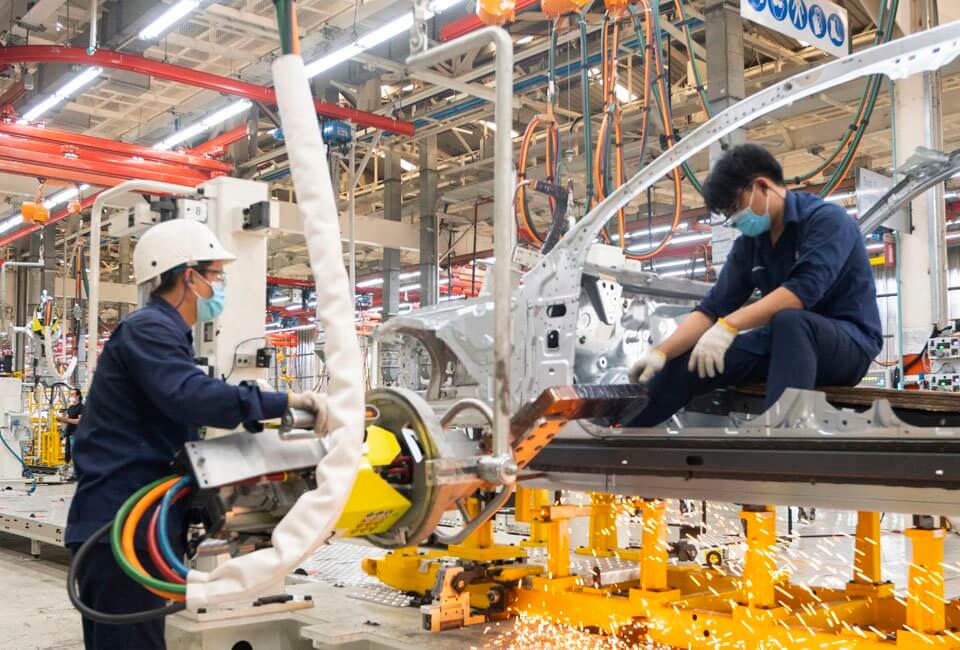 More than 1,900 establishments must conduct greenhouse gas inventories according to Decision No. 01/2022/QĐ-TTg (Illustration photo: internet)
Beyond these regulations, publicly listed companies are also mandated to conduct a greenhouse gas inventory. This is integrated into their annual reporting process (as outlined in Circular No. 96/2020/TT-BTC), where they must include environmental impact reports detailing total direct and indirect greenhouse gas emissions and outlining initiatives to reduce greenhouse gas emissions (Section 6, Part II, Appendix IV).
Finally, many businesses are proactively performing a greenhouse gas inventory, even beyond legal requirements. This voluntary action allows them to calculate their carbon footprint, establish a baseline for emission reduction planning, and pursue ambitious long-term goals like carbon neutrality and achieving Net Zero emissions.
Accompanying businesses conducting greenhouse gas inventories, aiming for carbon neutrality/Net Zero
For businesses seeking to understand and manage their environmental impact, a robust greenhouse gas inventory is the essential first step towards carbon neutrality and Net Zero goals. This process involves meticulous tracking and reporting of emissions, guided by recognized international standards and frameworks. Key resources include ISO 14064-1:2018, ISO 14064-2:2019, ISO 14064–3: 2019, ISO 14065:2020, The GHG Protocol Corporate Accounting and Reporting Standard, the United Nations Framework Convention on Climate Change (UNFCCC), and the Intergovernmental Panel on Climate Change (IPCC). Within Vietnam, relevant regulations and standards encompass Decree 06/2022/NĐ-CP, Decision 01/2022/QĐ-TTG, Circular 96/2020/TT-BTC, Decision 2626/2022-BTNMT, and National standards TCVN ISO 14064-1:2011, TCVN ISO 14064-2:2011, TCVN ISO 14064-3:2011.
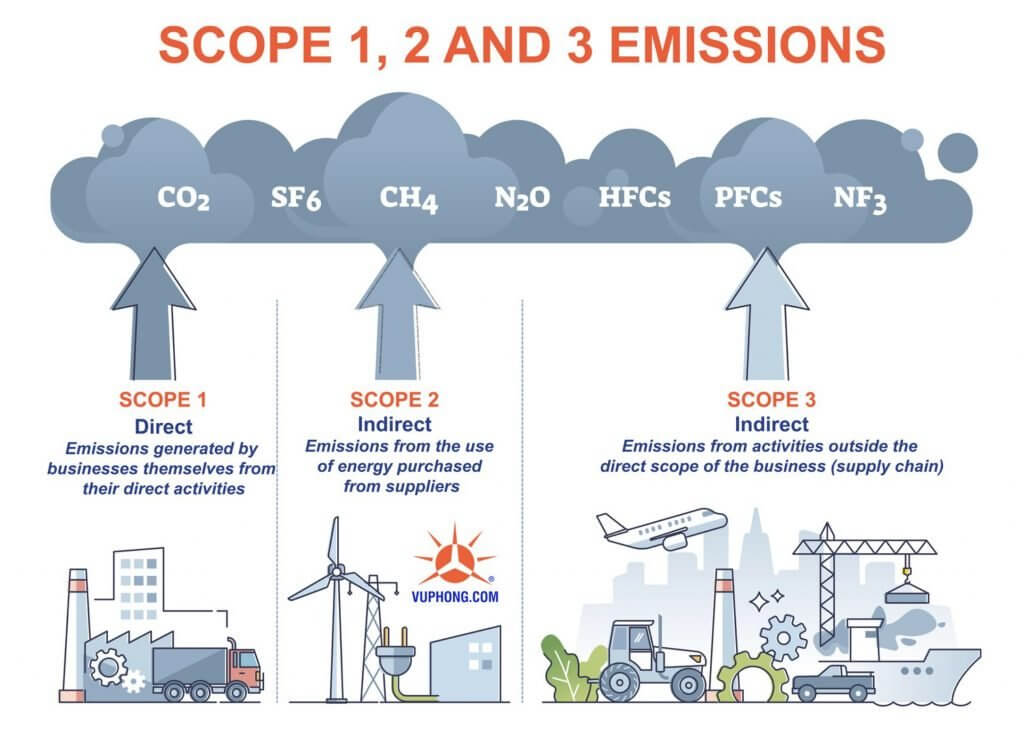 Greenhouse gas and the scope of greenhouse gas emissions of enterprises
Vu Phong Energy Group recognizes the increasing demand for expert guidance in this area. Through our specialized member, VP Carbon, we provide comprehensive services related to greenhouse gas inventory, emission reduction consulting, and pathways to carbon neutrality and Net Zero. Our expertise helps businesses navigate the complexities of environmental regulations and sustainability initiatives.
VP Carbon’s services offer a complete solution for managing and reducing greenhouse gas emissions, ensuring compliance with legal requirements while strengthening brand reputation among customers and partners. Beyond simply calculating emissions, we provide tailored advice on adopting eco-friendly production methods and transitioning towards carbon neutrality. By partnering with VP Carbon, businesses can optimize their time and resources, focusing on core operations while confidently meeting environmental obligations, enhancing market competitiveness, and advancing toward sustainable development. A thorough greenhouse gas inventory allows businesses to identify areas for improvement and track progress towards sustainability goals.
| Businesses in need of consulting on greenhouse gas inventory, emission reduction solutions, carbon neutrality, or Net Zero can contact VP Carbon at 1800 7171 or +84 9 1800 7171 or via email hello@vuphong.com to receive the fastest support from Vu Phong Energy Group! |
Vu Phong Energy Group
Vietnamese: “Dịch vụ kiểm kê khí nhà kính và tư vấn trung hòa carbon”
Recent Posts
-
 Unlocking Potential: How Mindset Drives Success at Vu Phong Energy Group
 -
 Vu Phong Handbook: Sustainable Solutions for Net-Zero & Digital Transformation
 -
 Vietnam’s Decree 135: Boost for Rooftop Solar Power & Green Transition
 -
 Zero Capex Solar: Vietnam’s Path to Net-Zero Emissions
 -
 Vu Phong Energy Group Achieves Key Milestones in Renewable Energy Transition – November 2024


