
The Emissions Trading System (ETS) Emissions Trading System is gaining traction as a critical tool for nations striving to curb pollution and embrace sustainable practices. As climate change intensifies and environmental regulations evolve, understanding how these systems function—and the challenges they face—is increasingly vital. This article provides a comprehensive exploration of ETS, from its core mechanics and economic impact to practical applications and the hurdles encountered in implementation worldwide. Join us as we unpack the nuances of this market-based approach to environmental stewardship and its role in shaping a more sustainable future.
Introduction to the Emissions Trading System (ETS)
Emissions Trading Systems (ETS) represent a market-based approach increasingly utilized within mandatory carbon markets established by governments worldwide. These systems aim to control greenhouse gas emissions within a specific geographic area by leveraging economic incentives to encourage emission reduction. The flexibility of ETS allows nations to adapt the system to their unique circumstances, potentially leading to more effective achievement of emission reduction targets and contributing to broader environmental protection.
At its core, an ETS functions according to fundamental market principles of supply and demand. A ‘cap’ is established, defining the total permissible emissions for participating entities. Emission allowances, which represent a portion of this cap, are then allocated, effectively acting as permits. Companies have the option to reduce their own emissions to retain these permits or purchase additional permits from other entities if their reduction efforts are insufficient. This creates a market for emission rights, and the price of these rights fluctuates based on the interplay of supply and demand factors.
The resulting market mechanism incentivizes innovation and efficiency. Companies are motivated to seek out the most cost-effective ways to reduce emissions, fostering technological advancements and improvements in energy efficiency – all while contributing to overarching climate goals. A well-designed Emissions Trading System can thus be a powerful tool for achieving meaningful environmental outcomes.
Moreover, an ETS isn’t solely a pollution control mechanism; it also fosters sustainable development by driving investments in cleaner technologies and more efficient processes. This encourages a shift towards a low-carbon economy and supports long-term environmental stewardship.
Types of Emissions Trading Systems
Emissions Trading Systems (ETS) offer a market-based approach to reducing greenhouse gas emissions, and two primary models are commonly employed: Cap-and-Trade and Baseline-and-Credit systems. Understanding these differing approaches is key to grasping the flexibility and adaptability inherent in emission reduction strategies.
1. Cap-and-Trade system
The Cap-and-Trade system is the most prevalent type of ETS globally, exemplified by the European Union Emissions Trading System (EU ETS). This system establishes a defined and declining limit, or “cap,” on the total amount of emissions permitted from participating entities. This overall cap is divided into allowances, each representing the right to emit a specific quantity of greenhouse gases, typically one ton of carbon dioxide equivalent. The system provides a tangible framework for managing emissions within carbon markets.
These allowances are distributed to regulated entities, often through a combination of free allocation and auctioning. Companies can then use these allowances to cover their own emissions, or they can sell surplus allowances in the market. This creates a financial incentive for emissions reductions: companies that can reduce their emissions more cost-effectively can profit by selling allowances, while those facing higher abatement costs can purchase them. This dynamic pricing helps ensure cost-effectiveness in meeting emission reduction goals.
2. Baseline-and-Credit system
The Baseline-and-Credit system operates differently. Instead of a fixed cap, it establishes a baseline emissions level for each participating business, often based on historical emissions data or sector-specific benchmarks. Businesses then undertake projects to reduce their emissions below this established baseline. These emission reductions are rigorously verified and converted into credits. These credits can then be sold to other businesses or used to satisfy their own emissions obligations. For more information on how this works, check out carbon markets.
Baseline-and-Credit systems are frequently applied in sectors where direct regulation is challenging or where setting absolute caps proves impractical. However, the implementation of this system requires careful monitoring and verification processes to ensure the accuracy and credibility of baseline levels and the resulting credits, adding a layer of complexity compared to a Cap-and-Trade approach.
Key Design Aspects of an Emissions Trading System (ETS)
Cap Setting
A well-designed Emissions Trading System (ETS) hinges on a carefully considered emissions cap. This cap represents the total amount of emissions allowed within the system and should align with broader, long-term climate goals. It’s crucial to build flexibility into the cap, allowing for adjustments over time as emissions reduction progress is evaluated and new technologies emerge. An overly generous cap diminishes the incentive to reduce emissions, while an excessively strict cap can lead to unsustainable costs for businesses and instability in the market. More information on the underlying principles can be found in carbon markets.
Allowance Allocation
Once the emissions cap is established, allowances – permits to emit a specified amount – must be distributed. Two primary methods exist: free allocation and auctioning. Free allocation is sometimes implemented to support industries facing significant economic challenges under the ETS, mitigating potential adverse impacts. Auctioning, conversely, promotes greater emissions reductions by encouraging businesses to seek out cost-effective abatement strategies and is generally viewed as a more transparent process. Understanding the complexities of these systems often requires looking at broader carbon markets.
The chosen allocation method significantly influences the economic efficiency and perceived fairness of the Emissions Trading System. Auctioning, for example, generates revenue for the governing body, which can be reinvested in green technologies or other environmental initiatives, but it also increases the direct costs faced by participating businesses.
Monitoring, Reporting, and Verification (MRV)
Robust Monitoring, Reporting, and Verification (MRV) procedures are indispensable for the integrity and effectiveness of any Emissions Trading System. This system ensures the accurate measurement of emissions, their full and transparent reporting, and independent verification of those reports. A rigorous MRV process fosters trust in the system, detects and addresses non-compliance, and contributes significantly to the overall fairness and success of the ETS.
Economic Impacts of Emissions Trading Systems (ETS)
Encouraging Technological Innovation
Emissions Trading Systems (ETS) provide a significant economic incentive for companies to adopt cleaner and more efficient technologies. As the cost of emission allowances increases, investments in technologies that reduce emission reduction> become increasingly attractive. This encourages the development and implementation of advanced solutions, leading to reduced emissions, improved operational efficiency, and the creation of new business ventures. The drive for innovation spurred by ETS can lead to long-term economic and environmental benefits. This is further explored within the broader carbon markets.
Market Value and Price Stability of Emission Allowances
The price of emission allowances within an ETS is determined by the fundamental forces of supply and demand. Scarcity drives prices upward, incentivizing businesses to minimize their emissions. However, price volatility can introduce uncertainty, particularly for industries requiring flexible production processes. To mitigate this, well-designed Emissions Trading Systems often incorporate mechanisms like price floors and ceilings to promote greater predictability and stability in the market. Understanding the complexities of these mechanisms is key to navigating the evolving carbon markets.
Economic Efficiency and Environmental Sustainability
Emissions Trading Systems are widely recognized as a cost-effective mechanism for achieving emission reduction targets. By allowing businesses the flexibility to determine their compliance strategies, ETS fosters the pursuit of innovative and economically viable solutions. Ultimately, the success of an ETS hinges on its robust design and effective management, encompassing elements such as setting appropriate caps, allocating allowances fairly, and implementing robust Measurement, Reporting, and Verification (MRV) protocols to ensure integrity and accountability.
Practical Applications and Challenges
Case Studies on Emissions Trading Systems (ETS) Around the World
The European Union Emissions Trading System (EU ETS) stands out as a notable example of the potential of Emissions Trading Systems (ETS). Launched in 2005, it has evolved into the world’s largest carbon markets, encompassing over 11,000 power plants and industrial facilities across 30 countries. The EU ETS has demonstrably contributed to reducing Europe’s CO2 emissions, spurred technological innovation, and generated substantial revenue through emission allowance auctions.
However, the implementation of ETS has not been universally successful. Some systems have encountered significant hurdles in design and enforcement, resulting in inefficient markets that have struggled to meet emission reduction targets. These challenges underscore the need for careful planning and robust oversight in any ETS initiative.
Current Status of Emissions Trading System (ETS) Development in Various Countries
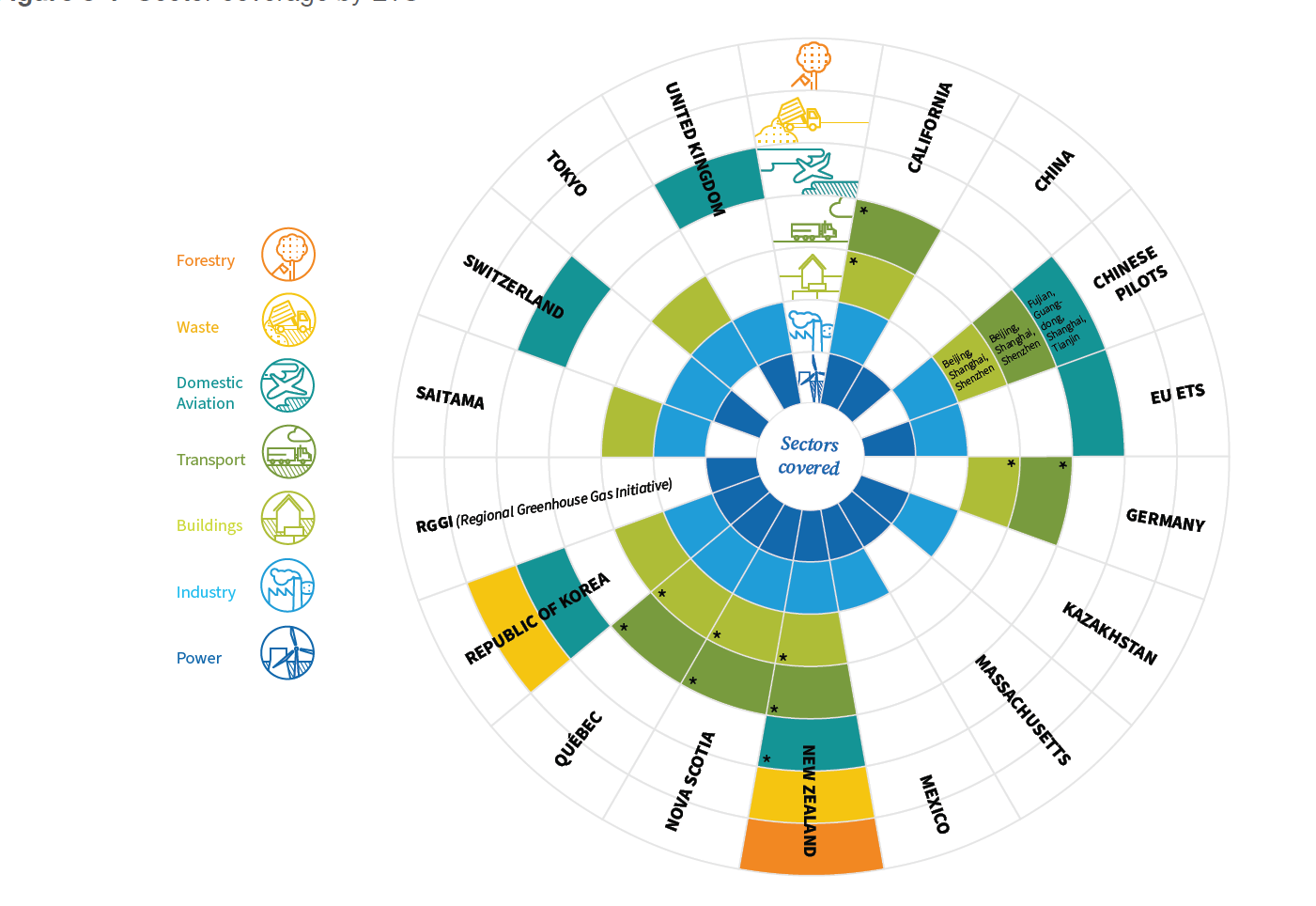
European Union (EU): The EU ETS, initiated in 2005, represents the most established and comprehensive ETS globally. For the period of 2021-2030, the EU aims for a 55% reduction in CO2 emissions compared to 1990 levels. The system currently covers approximately 11,000 industrial facilities across 30 countries, generating roughly 55 billion euros in auction revenue in 2022. Ongoing discussions focus on volatile emission allowance prices and the allocation of free allowances.
China: China’s ETS, launched in 2021, is the largest in the world by coverage, encompassing roughly 30% of the nation’s total emissions. Initially focused on the power sector, it is planned to expand to other industries. In 2023, the China ETS generated around 6 billion USD through emission allowance auctions, but it faces challenges related to transparency and overall effectiveness in driving emissions reductions.
United States: The U.S. employs two primary ETS systems: California’s Cap-and-Trade and the Regional Greenhouse Gas Initiative (RGGI). California’s system, operational since 2013, covers approximately 85% of the state’s emissions and has achieved a roughly 10% reduction in CO2 emissions compared to 2012 levels, with auction revenue reaching around 1 billion USD in 2023. RGGI, a coalition of 11 eastern U.S. states, is currently exploring expansion and stricter emission reduction measures. Key considerations include achieving harmonization across state lines and addressing the allocation of free emission allowances.
South Korea: The South Korea ETS, launched in 2015, was the first national ETS in East Asia. It currently covers roughly 70% of the country’s emissions and facilitated a 4% reduction in CO2 emissions between 2015 and 2020. Emission allowance auctions generated approximately 600 million USD in 2023. Efforts are underway to ensure fairness and improve the efficiency of the system.
Canada: Canada operates a federal ETS mechanism alongside provincial systems in Québec and Ontario, both of which began in 2019. The federal system contributed to a roughly 2% reduction in CO2 emissions in 2023. Provincial auction revenue reached approximately 500 million CAD in 2023. A key priority is fostering coordination and cooperation between federal and provincial initiatives.
Japan: Japan has implemented a carbon markets system in urban areas such as Tokyo and Saitama since 2010. This system has reduced CO2 emissions by around 10% in participating regions, with Tokyo’s carbon credit sales generating approximately 200 million USD in 2023. The focus now is on expanding the system and better aligning it with international mechanisms.
In Vietnam, government agencies are actively developing a voluntary carbon credit market through the implementation of policies like Decree 06/2022/ND-CP, Decision 01/2022/QD-TTg, and Circular 01/2022/TT-BTNMT. A pilot carbon credit market is slated for establishment under Resolution No. 98/2023/QH15 dated June 24, 2023. For instance, Ho Chi Minh City is promoting green growth through policy frameworks and action plans incorporating components related to the carbon credit market. The city is also committed to initiatives such as developing a green Can Gio, afforestation programs, urban environment improvements, renewable energy adoption, green village models, and the promotion of a blue economy.

Emissions Trading Systems (ETS) have demonstrated their ability to curb environmental pollution and encourage innovation. Nevertheless, significant challenges persist in order to enhance the efficiency and fairness of these systems. Countries worldwide are adapting and refining their ETS mechanisms to align with their emission reduction and climate goals. The continued success and broader adoption of ETS will depend on the collective ability of nations to reform and harmonize their climate policies.
Vu Phong Energy Group
Recent Posts
-
 Unlocking Potential: How Mindset Drives Success at Vu Phong Energy Group
 -
 Vu Phong Handbook: Sustainable Solutions for Net-Zero & Digital Transformation
 -
 Vietnam’s Decree 135: Boost for Rooftop Solar Power & Green Transition
 -
 Zero Capex Solar: Vietnam’s Path to Net-Zero Emissions
 -
 Vu Phong Energy Group Achieves Key Milestones in Renewable Energy Transition – November 2024


